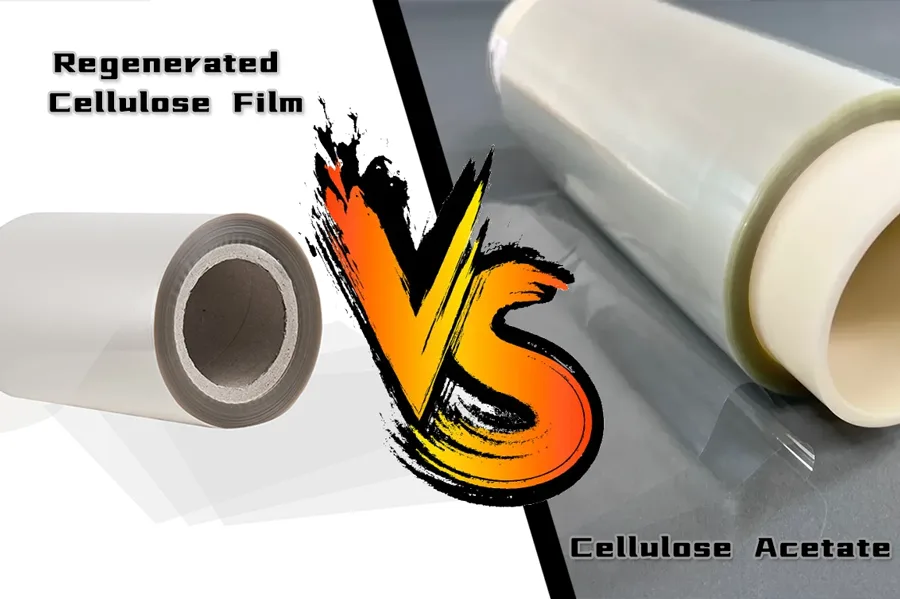
Regenerated Cellulose Film vs. Cellulose Acetate: How to Choose
Regenerated cellulose film and cellulose acetate film are both cellulose-based materials, but they are not the same material. Regenerated cellulose film is primarily made from regenerated cellulose, while cellulose acetate film is a chemically modified cellulose derivative. Both can be transparent, glossy, printable, and suitable for packaging and other converting applications. However, they differ in moisture behavior, heat sealing, dimensional stability, degradation, and regulatory considerations.
For buyers, the important question is not which material is simply “better.” The real question is whether the material structure and performance match the intended application.
Why Are These Two Films So Easily Confused?
At first glance, regenerated cellulose film and cellulose acetate film can look very similar. Both can be made into clear films, as well as colored, glossy, and printable grades. Their applications also overlap in areas such as packaging, adhesive tapes, labels, and decorative materials.
The confusion often starts with terminology. “Cellulose film” is sometimes used broadly for different cellulose-based films, while supplier documents may not clearly identify the polymer type. For purchasing teams, a product name or visual sample alone is not enough to determine what a film is actually made from.
This is more than a naming issue. Different polymer structures affect moisture sensitivity, converting behavior, end-use performance, and degradation after disposal. When a supplier simply describes a product as “cellulose film,” it is worth confirming the specific polymer type.
What Is the Chemical Difference?
Manufacturers generally make regenerated cellulose film from refined cellulose derived from sources such as wood pulp or cotton pulp. The process dissolves the cellulose, regenerates it, and forms it into a continuous film structure. The cellulose is dissolved, regenerated, and formed into a continuous film structure. Because the main polymer remains cellulose, the material retains characteristics associated with cellulose, including hydrophilicity, breathability, and a natural basis for biodegradation.
Cellulose acetate film Cellulose acetate film is a cellulose derivative. Manufacturers produce it by chemically modifying cellulose through acetylation of some of the hydroxyl groups in the cellulose structure. The degree of acetylation affects properties such as hydrophobicity, mechanical behavior, dimensional stability, and degradation.
In simple terms, both materials start with cellulose, but they follow different material routes. Regenerated cellulose is re-formed into a continuous film, while cellulose acetate is chemically modified before being processed into a film.
Performance Differences That Matter in Purchasing
| Property | Regenerated Cellulose Film | Cellulose Acetate Film | What It Means for Buyers |
|---|---|---|---|
| Polymer structure | Primarily regenerated cellulose | Chemically modified cellulose derivative | Determines basic material behavior and processing characteristics |
| Transparency and gloss | Can provide high transparency and gloss; available in colored and printable grades | Also available in clear and colored grades | Both can meet visual packaging requirements; compare specific grades |
| Moisture behavior | More hydrophilic and sensitive to humidity changes | Generally more hydrophobic | Important for storage, converting, and humid environments |
| Breathability | Some uncoated grades offer useful moisture and gas permeability | Generally does not provide the same breathability | Relevant to produce, bakery, and other applications requiring gas exchange |
| Heat sealing | Uncoated film is not normally selected for heat sealing; suitable coatings can provide sealability | Some grades can be designed for specific sealing applications | Final film structure and packaging equipment must be considered |
| Dimensional stability | More sensitive to changes in temperature and humidity | Generally offers better dimensional stability | Important in high-speed converting and dimension-sensitive applications |
| Static behavior | Generally has a relatively low tendency to build static | Depends on grade and processing conditions | Relevant to slitting, printing, and clean processing |
| Degradation | Cellulose itself provides a strong basis for biodegradation | Depends on degree of acetylation, formulation, and environment | Environmental claims should always be supported by product-specific testing |
The key point is that the material name does not tell the whole story.
For example, an uncoated regenerated cellulose film and a coated regenerated cellulose film can have very different heat-sealing, barrier, and moisture properties. The same principle applies to cellulose acetate, where different grades can be designed for different processing requirements.
For purchasing decisions, it is therefore better to compare the complete film structure rather than compare only the names “regenerated cellulose film” and “cellulose acetate film.”
Biodegradation and Compostability: Look Beyond the Word “Cellulose”
This is one of the areas where the two materials are most often misunderstood.
Regenerated cellulose has a natural basis for biodegradation, which is why uncoated and specifically designed regenerated cellulose films are used in biodegradable and compostable packaging systems. However, whether a finished product qualifies for a particular biodegradable or compostable claim depends on its formulation, coatings, additives, and the relevant test requirements.
Cellulose acetate should not simply be classified as “non-biodegradable” either. Its degradation behavior can vary with the degree of acetylation and the surrounding environment. Research has shown that some cellulose acetate materials with a lower degree of substitution can show good biodegradation under controlled composting conditions, while behavior can differ under other conditions.
For this reason, claims such as industrially compostable or home compostable should always be supported by testing and certification for the specific finished product.
It is also important to distinguish between biodegradability, compostability, and degradation in marine environments. These claims involve different conditions and evaluation methods. One test result should not be used to support another claim.
Food Contact Compliance Depends on the Complete Material Structure
Both materials can be used in packaging, but food contact compliance depends on the specific formulation, additives, coatings, and conditions of use.
In the EU, regenerated cellulose film used for food contact applications is covered by a specific regulatory framework. The relevant requirements address the composition of regenerated cellulose film and the substances permitted in its manufacture. They also distinguish between uncoated film, cellulose-coated film, and film with plastic coatings.
This is important because saying that “regenerated cellulose film is suitable for food contact” does not mean that every regenerated cellulose product can be used for every food application without further assessment. The film, coating, printing system, and intended conditions of use all matter.
The same principle applies to cellulose acetate. Its suitability for food contact should be checked against the specific grade, formulation, and regulations in the target market.
For export purchasing, the supplier’s technical and compliance documentation is therefore often more useful than the product name itself.
Incoming Inspection: Do Not Rely on Appearance Alone
When a supplier only describes a material as “cellulose film,” the purchasing team should confirm the polymer type before the material enters regular production.
Simple observations such as water behavior, flexibility, or burning characteristics may provide clues, but they are not reliable methods for formally identifying a polymer. Burning behavior can also be affected by coatings, additives, and film construction, so it should not be treated as a definitive identification method.
A better approach is to review the Technical Data Sheet (TDS), Safety Data Sheet (SDS), material declaration, and relevant third-party test reports. For food packaging, food-contact compliance documents and intended-use conditions should also be checked.
If a supplier cannot clearly state what polymer the film is made from, a product photograph or visual sample alone is not enough to determine whether the material is suitable for your production process.
Color, Printing, and Converting
From a visual perspective, both materials can be produced as clear or colored films and can be printed. Color and gloss alone therefore cannot reliably identify the material.
Regenerated cellulose film has relatively high surface energy and generally offers good printability. Depending on the film structure and ink system, some grades can be printed directly, while others use coatings or other surface treatments. Its relatively low tendency to build static can also be helpful in high-speed slitting, printing, and other roll-to-roll processes.
Cellulose acetate can also be used for printing and decorative applications, but its actual performance depends on the grade, surface condition, and converting process.
If a project requires tight color consistency, high printing speeds, static control, or stable slitting performance, the better approach is to compare technical specifications and run an actual converting trial. The material name tells you what the film is. It does not tell you exactly how it will behave on your equipment.
When Is Regenerated Cellulose Film the Better Choice?
If a project places strong emphasis on plant-based materials, biodegradability, or a compostable packaging system, regenerated cellulose film is often worth considering first.
It also offers high transparency, good gloss, natural stiffness, relatively low static behavior, and useful breathability in certain grades. These properties have supported its long-standing use in confectionery twist wrapping, food packaging, gift packaging, floral wrapping, and other specialty applications.
Different coatings and converting methods can further change its heat-sealing, barrier, and processing performance.
For applications that place greater emphasis on moisture resistance, dimensional stability, or specific industrial processing requirements, cellulose acetate may be the better choice. It is not simply a replacement for regenerated cellulose film. It is a cellulose derivative with a different set of material characteristics.
The final decision should therefore start with the application rather than with the question of which material is more sustainable or more advanced.
Five Things to Confirm Before You Buy
First, confirm the polymer type. Is it regenerated cellulose or cellulose acetate? The term “cellulose film” alone is not specific enough.
Second, confirm the complete film structure. Does it contain coatings, plasticizers, pigments, adhesives, or other functional additives? These components can affect both performance and compliance.
Third, confirm the actual conditions of use. Does the packaging require heat sealing, moisture resistance, breathability, high-speed printing, or long-term storage? The film needs to match the equipment and environment.
Fourth, check the basis for environmental claims. If a product is described as biodegradable, compostable, or plastic-free, ask for the relevant test reports, certifications, or compliance documentation.
Fifth, review the technical documents. A TDS, SDS, food-contact declaration, and third-party test report are usually much more useful than a vague product description.
So, Which One Should You Choose?
Regenerated cellulose film and cellulose acetate film are both cellulose-based materials, but they are designed around different material characteristics.
If you need a transparent film based on regenerated cellulose and the project places importance on plant-derived materials, biodegradability, or compostable packaging systems, regenerated cellulose film is worth serious consideration.
If the application places greater emphasis on moisture resistance, dimensional stability, or particular processing requirements, different grades of cellulose acetate should also be evaluated.
For purchasing teams, the safest approach is to work backward from the application. Define the required performance first, then confirm the polymer, coating, additives, and compliance documentation. That is the most reliable way to avoid buying a film that looks similar to the one you need but is actually a different material.