How to Choose Cellulose Film Thickness: GSM, Microns and Applications
When buying cellulose film, one of the first questions is usually simple:
What thickness do you need?
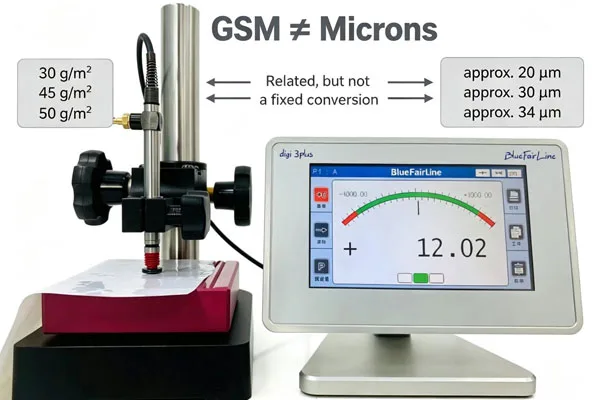
The answer may come in two different forms. A supplier may quote GSM, while a buyer may ask for microns. These two measurements are related, but they are not the same.
For packaging companies, tape manufacturers, and film converters, understanding the difference helps avoid the wrong specification. It also makes it easier to compare cellulose film from different suppliers.
So, if you are choosing between 25, 30, 35, 40, or 45 g/m² cellulose film, what does the difference actually mean?
GSM vs. Microns: What Do They Actually Mean?
GSM means grams per square meter (g/m²). It is also called basis weight. It tells you how much one square meter of film weighs.
Micron, written as μm, measures physical thickness. One micron equals 0.001 mm.
In Chinese film trading terms, you may also hear “丝” (si). One “丝” is commonly used to mean 0.01 mm, or 10 μm. It is a trade expression rather than a formal international unit.
These measurements answer different questions:
GSM: How much does the film weigh per square meter?
Microns: How thick is the film?
“Silk” / 丝: A Chinese trade term used to describe thickness.
GSM is useful for calculating material consumption and comparing the weight of different grades. Microns are more directly related to the physical thickness of the film.
That difference matters when you are preparing a converting process or comparing products from different manufacturers.
Can GSM Be Converted Directly to Microns?
Not with one universal conversion factor.
The relationship can be simplified as:
Basis weight = apparent density × thickness
This means that GSM and thickness are connected through the film’s apparent density. If two films have different formulations, moisture contents, or manufacturing conditions, the same GSM does not necessarily give exactly the same thickness.
For regenerated cellulose film, moisture is also important. Water can change the physical dimensions and mechanical behavior of the film. Research has also shown that moisture strongly affects the oxygen barrier performance of regenerated cellulose films.
A real example from KEDE
KEDE’s production data provides a useful reference:| Basis Weight | Approx. Thickness | KEDE Production Reference |
|---|---|---|
| 30 g/m² | approx. 20 µm | Actual production data |
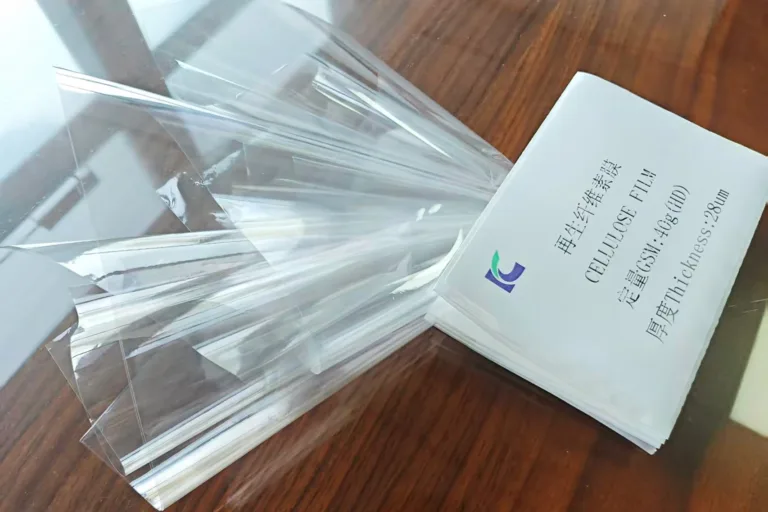
| 40 g/m² | approx. 28 µm | Actual production data |
| 45 g/m² | approx. 30 µm | Actual production data |
| 50 g/m² | approx. 34 µm | Actual production data |
How Does Thickness Affect Cellulose Film Performance?
A higher basis weight usually means more film material per square meter. A thicker film can also feel more substantial during handling and converting.One of the clearest differences is stiffness.For a single-layer film with similar material properties, bending stiffness is approximately related to the cube of thickness. In simple terms, a small increase in thickness can make a noticeable difference in how the film bends and handles.This does not mean that every mechanical property increases at the same rate.Tensile strength, elongation, tear resistance, and puncture resistance also depend on the cellulose structure, orientation, formulation, moisture content, and production process. Thickness is only one part of the specification.Material consumption also changes directly with basis weight. A 45 g/m² film uses more material per square meter than a 30 g/m² film. For high-volume packaging, this difference can affect both roll weight and material cost.Does a Thicker Cellulose Film Always Perform Better?
Not necessarily.A thicker film can provide more body and stiffness, but thickness alone does not determine barrier performance.This is especially important for cellulose film because moisture has a strong effect on its properties. Under dry conditions, regenerated cellulose can provide good oxygen barrier performance. As moisture increases, oxygen permeability can rise significantly. Water vapor transport also depends strongly on humidity and the moisture content of the film.For this reason, simply choosing a thicker uncoated film is not always the best way to improve moisture or gas resistance.If the application needs stronger moisture, oxygen, or aroma protection, a suitable coating or film structure may be more effective than increasing the base film thickness alone.What about heat sealing?
Thickness does not automatically make cellulose film heat-sealable.An uncoated regenerated cellulose film does not become heat-sealable simply because it is thicker. Heat-sealing performance normally comes from a suitable coating or sealing layer.So, if your packaging process requires heat sealing, tell the supplier about this requirement before selecting the GSM.Comparing 25–45 g/m² Cellulose Film
For many buyers, the practical question is not “How many microns is cellulose film?” but rather:
Which GSM should I choose?
There is no single GSM for every application. However, comparing the common grades helps show the general difference.
| Basis Weight | General Character | Where It May Fit |
|---|---|---|
| 25 g/m² | Lightweight and flexible | Light wrapping, specialty converting |
| 30 g/m² | Light but more substantial | Wrapping, twist applications, general converting |
| 35 g/m² | Medium weight | General packaging and converting |
| 40 g/m² | More body and stiffness | Packaging requiring a firmer feel |
| 45 g/m² | Heavier and more substantial | Applications requiring greater film body or handling strength |
These are selection references, not fixed application rules.
For example, a twist-wrapping application may use a relatively light film, while another customer may choose a heavier grade because of the machine settings, package size, or desired handling characteristics.
The right grade depends on the complete converting process, not GSM alone.
Which GSM Is Right for Your Application?
Start with the way the film will be used.
For food and gift wrapping, appearance, handling, folding, and package size all matter.
For twist wrapping, the film needs to form and hold the twist properly. Dead-fold behavior can be more important than simply choosing the highest GSM.
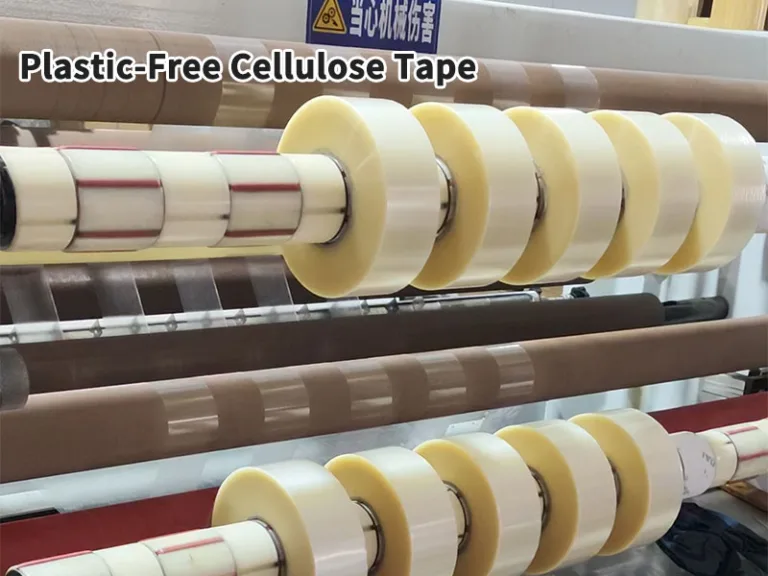
For adhesive tape, the film must run smoothly through coating, slitting, and rewinding. Tensile strength and dimensional stability also become important.
For specialty converting, the required thickness may depend on the machine, finished product structure, coating, or lamination process.
This is why experienced buyers normally do not specify only “30 GSM cellulose film.” They provide the application and converting requirements as well.
What Should Buyers Include in an RFQ?
A clear specification makes supplier comparison much easier.
For a cellulose film inquiry, consider providing:
- Basis weight, such as 30 or 45 g/m²
- Required thickness in μm
- Thickness tolerance
- Film width
- Roll or sheet format
- Required roll length or finished roll weight
- Uncoated or coated structure
- Intended application
- Food-contact requirements, if applicable
- Required technical documents or certificates
If you already have a target thickness, provide both GSM and μm when possible. This reduces misunderstandings during production.
KEDE Cellulose Film: 20–60 g/m²
KEDE supplies regenerated cellulose film in a 20–60 g/m² range, in both roll and flat sheet formats.
Within this range, 25–45 g/m² covers many of the grades regularly requested by customers. However, the suitable grade still depends on the application and converting requirements.
KEDE’s production data also shows why buyers should not rely on a generic GSM-to-micron formula. For example, 30 g/m² is approximately 20 μm, while 50 g/m² is approximately 34 μm.
These values provide a practical reference for KEDE film selection. Final thickness should always be confirmed against the actual product specification and tolerance.
There Is No Single “Best” Cellulose Film Thickness
Choosing cellulose film thickness is not about finding the thickest or thinnest option.
GSM tells you the basis weight. Microns tell you the physical thickness. Their relationship depends on the material and production conditions.
Thickness affects handling, stiffness, and material consumption. But barrier performance, sealing, mechanical properties, and converting behavior depend on more than thickness alone.
For that reason, the best specification is usually a combination of basis weight, thickness, tolerance, film structure, and application requirements.
If you are comparing 25–45 g/m² cellulose film, start with the actual converting requirement. Then confirm the GSM and micron specification with your supplier.