Plastic-Free Cellulose Tape:Material Structure and Degradation in Sustainable Packaging
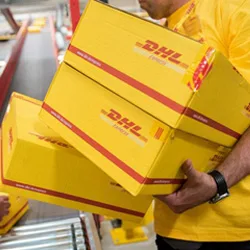
In modern logistics and product packaging, tape represents only a small part of the total packaging weight. However, it remains one of the hardest materials to replace in sustainable packaging systems.
Traditional sealing tapes made from BOPP have dominated the market for decades because of their low cost and stable mechanical performance. Today, environmental concerns and packaging regulations are pushing the industry to look for alternative materials.
As a packaging tape based on natural cellulose, cellulose tape is now appearing in more sustainable packaging applications. Because the backing material comes from natural cellulose, cellulose tape is often classified as a plastic-free packaging material in environmental compliance reviews and material assessment systems.
1. Environmental Issues of Traditional Plastic Tape
To understand the value of cellulose tape, it is important to first look at the environmental impact of conventional plastic tapes.
Most carton sealing tapes use BOPP (biaxially oriented polypropylene) film together with acrylic pressure-sensitive adhesives. In natural environments, these materials usually do not fully disappear. Instead, they gradually break down into smaller plastic particles that may enter soil and water systems.
Plastic tape also creates problems during paper recycling. During the pulping process, residual tape and adhesive can form sticky contaminants known as “stickies.” These materials may block filters, affect recycled paper quality, and reduce recycling efficiency in paper mills.
In addition, BOPP originates from fossil-based resources, and its production process involves considerable carbon emissions.
2. The Regulatory Definition of “Plastic-Free”
Under guidance related to the EU Single-Use Plastics Directive (SUPD), whether a material is considered plastic does not depend only on appearance. Regulators also examine the polymer source and the level of chemical modification involved during production.
Materials based on natural polymers may not be classified as plastics when the production process does not involve significant chemical modification.
Natural cellulose and natural rubber both belong to natural polymer systems. Because of this, cellulose tape made from regenerated cellulose film and natural adhesive systems has become part of the growing plastic-free packaging sector.
3. Why Regenerated Cellulose Film Can Be Used for Tape
Some people assume plant-based materials cannot meet the strength and processing requirements of packaging tape.
In reality, regenerated cellulose film has been used in packaging applications for decades, including food packaging, twist wrapping, and industrial winding.
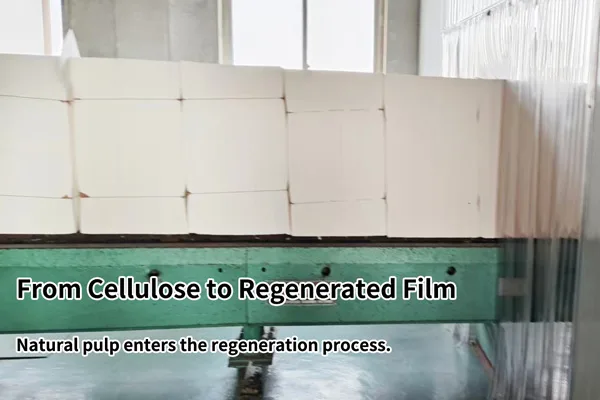
The film is produced from natural cellulose sources such as wood pulp and cotton pulp. After regeneration, the material forms a continuous and uniform film structure with stable physical properties suitable for tape processing.
The full regeneration and film-forming process is explained in more detail in Natural Cellulose Film – Sustainable Packaging for the Future.
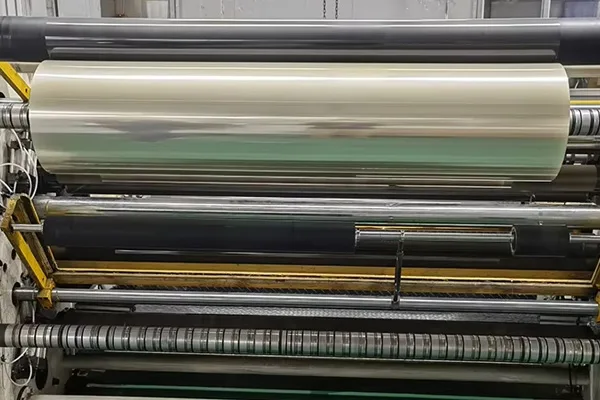
Compared with conventional plastic films, cellulose film typically offers:
- good tensile strength for general packaging applications;
- higher stiffness and fold retention;
- naturally lower static behavior;
- high surface energy that supports adhesive coating and bonding.
These characteristics allow cellulose film to be used in packaging tape, labels, twist wrapping, and other specialty packaging applications.
4. How Different Adhesive Systems Affect Cellulose Tape
Tape performance depends not only on the backing film, but also on the adhesive system.
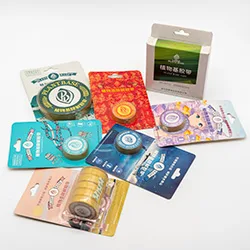
Common adhesive systems used in cellulose tape include natural rubber, natural resin, and bio-based hot melt adhesives. Each system shows different behavior in tack, temperature resistance, converting performance, and end-use applications.
Natural Rubber Based Systems
Natural rubber adhesives are widely used in compostable and cellulose-based tapes. They generally provide stable adhesion and good temperature adaptability.
These systems are commonly used for carton sealing and paper packaging applications.
Natural Resin Based Systems
Natural resin adhesive systems are often combined with plant-based materials in plastic-free packaging structures.
They usually show stable bonding performance on paper and cellulose film surfaces and are commonly used in stationery and light packaging applications.
Bio-Based Hot Melt Systems
Bio-based hot melt adhesives are typically applied through solvent-free coating processes. They are suitable for high-speed converting and industrial-scale production.
Different formulations may show different levels of initial tack, temperature resistance, and degradation behavior.
5. Environmental Standards and Degradation Testing
For plant-based packaging materials such as cellulose tape, international markets focus not only on whether the material can degrade, but also on raw material sourcing, chemical safety, and environmental impact after decomposition.
As a result, these products are often associated with standards and compliance systems such as FSC, REACH, EN 13432, and ASTM D6400.
FSC mainly evaluates whether pulp-based raw materials come from responsibly managed sources. REACH and SDS documentation focus on chemical compliance and material safety.
In compostability testing, EN 13432 and ASTM D6400 evaluate more than simple degradation. They also assess:
- disintegration behavior;
- heavy metal limits;
- ecotoxicity after composting.
Some ecotoxicity tests continue by evaluating seed germination and plant growth performance in composted soil to confirm that the material does not create harmful effects in the environment.
In addition to laboratory compostability tests, some materials also undergo natural soil degradation monitoring.
According to third-party testing data from KEDE cellulose tape products:
- natural rubber based tape showed degradation in about 77 days;
- bio-based hot melt tape showed degradation in about 108 days.
Actual degradation speed depends on temperature, humidity, microbial activity, and soil conditions.
6. Packaging Applications of Cellulose Tape
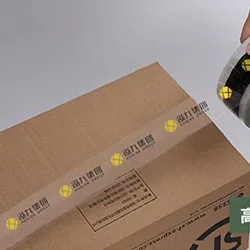
Compared with conventional plastic tape, cellulose tape is more commonly used in packaging applications that emphasize sustainable materials, recyclability, and packaging compatibility.
Typical applications include:
- e-commerce and logistics packaging;
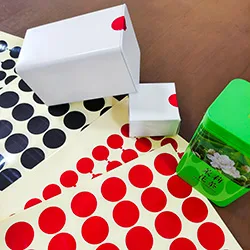
- stationery and office tape;
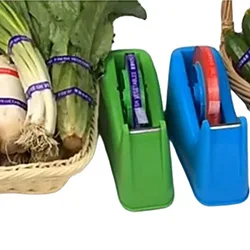
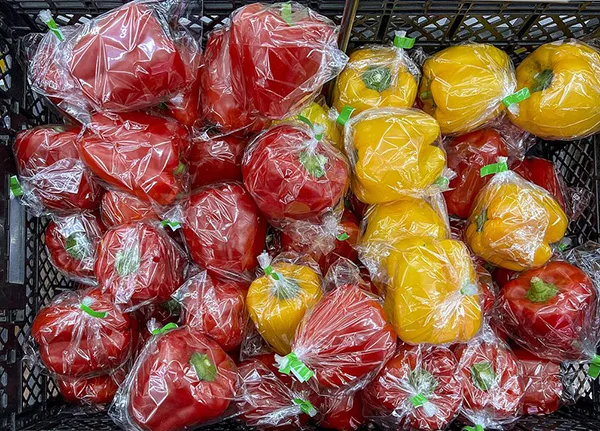
- food and gift packaging;
- fruit and bakery packaging;
- recyclable paper-based packaging systems.
Compatibility with paper recycling systems has also become an important topic in the packaging industry.
As plastic-free and compostable packaging continue to develop, cellulose tape is gradually expanding into more packaging applications.